
Hostel vs Airbnb Cost: Which Is Cheaper for Your Trip?
Hostel vs Airbnb cost is one of the first things budget travelers try to pin down, and the honest answer is that it depends less on branding than on how many people are splitting the room. As a rule, a hostel dorm bed is the cheapest way for a solo traveler to sleep in almost every city on Earth. An Airbnb, by contrast, usually becomes the better per-person deal once you have two or three people sharing one private space.
That rule comes with a long list of exceptions, which is exactly why the raw sticker price can mislead you. A $12 hostel bed in Bangkok and a $38 Airbnb room in Lisbon tell two very different stories once you add up taxes, cleaning fees, and what you actually get inside the door. Here’s the full breakdown, with real numbers.
What a Hostel Bed Actually Costs
Hostel pricing is the easiest to predict because the product is so standardized: a bunk in a shared room with a shared bathroom, plus a locker and usually a common kitchen. Prices track the local cost of rent, not the quality of the mattress.
Here’s what a dorm bed costs per night in popular destinations:
- Bangkok, Thailand: $8–$15
- Lisbon, Portugal: $18–$30
- Mexico City, Mexico: $10–$20
- Berlin, Germany: $25–$38
- Amsterdam, Netherlands: $35–$55
- New York City, USA: $45–$80
- Sydney, Australia: $30–$50
Private rooms inside hostels land somewhere between a dorm bed and a hotel room. In Western Europe, expect to pay $70–$120 for a hostel double room, while in Southeast Asia the same room often costs $25–$45. Hostels almost never charge cleaning fees on top of the listed price, though some add a local city tax of a dollar or two per night that you pay at reception.
The catch is privacy and noise. You are buying a bed, not a room, and the savings come directly out of personal space, quiet, and the security of leaving your things out in the open. Rick Steves’ hosteling guide is a good primer on what dorm life, private rooms, and hostel etiquette actually look like before you commit.
What an Airbnb Stay Actually Costs
Airbnb sticker prices look competitive until the checkout screen loads. The nightly rate you see on a map is rarely what you pay, because Airbnb stacks on fees that hostels simply don’t have.
The standard charges on a typical Airbnb booking are:
- Nightly rate: the advertised number
- Cleaning fee: a one-time $25–$80 charge, occasionally higher
- Airbnb service fee: roughly 14% of the subtotal
- Occupancy taxes: 5–15% depending on the city
A room listed at $60 per night for two nights can easily become $185 after a $40 cleaning fee, a $19 service fee, and taxes. That is a real-world breakdown, not a worst case. The shorter your stay, the more that fixed cleaning fee hurts, because it does not get cheaper if you only stay one night.

Photo by Ketut Subiyanto via Pexels
Hostel vs Airbnb Cost: A Side-by-Side Comparison
When you put the two options next to each other, the pattern is consistent: hostels win for solo travelers, Airbnbs win for groups. Here is how they compare on the factors that actually move the price.
| Factor | Hostel | Airbnb |
|---|---|---|
| Solo traveler, 1 night | $15–$60 dorm bed | $40–$90 private room |
| Price per night | Fixed, low | Falls as you add guests |
| Cleaning fee | None | $25–$80 one-time |
| Service fee | None (usually) | ~14% of subtotal |
| Kitchen access | Shared, free | Often full kitchen |
| Privacy | None in a dorm | Full, you get the key |
| Minimum stay | 1 night | Sometimes 2+ nights |
The single biggest number in that table is the cleaning fee, because it punishes short bookings. A solo traveler staying one night in a $50 Airbnb private room pays $50 plus a $35 cleaning fee plus fees — roughly $95 for one night, at which point a $30 hostel bed in the same city looks almost too good to be true.
The Hidden Fees That Change the Math
Both options have add-ons that the booking page hides or de-emphasizes, and ignoring them is how travelers blow their budget by accident.
Airbnb’s layered fees. The cleaning fee is not the only add-on. Airbnb now displays a “total price” toggle in many regions, but hosts can still set a higher nightly rate for weekends. Some also charge extra for a second guest, in which case a “whole place” stops being a flat-rate bargain. Property taxes in cities like Amsterdam, Barcelona, and New York add another 5% to 12%.
Hostel’s quiet upcharges. Hostels advertise a bare-bones rate, then sell everything else separately. A locker padlock is $2–$5 if you did not bring one. Breakfast, when offered, runs $5–$10. Towels are free in some hostels and $2–$4 to rent in others. Laundry machines are coin-operated. A week of these small charges can quietly add $40–$60 to a hostel stay, though you can skip most of them by packing a towel and a padlock.
The time cost. This one shows up nowhere on an invoice, but it is real. A $15 hostel bed with a 20-minute check-in line, a dorm of snoring strangers, and a shower queue at 8 a.m. costs you sleep and energy. When you are comparing an overnight layover before an early flight, that matters more than the $12 you saved.
When a Hostel Is Clearly the Cheaper Choice
Hostels dominate in four specific situations, and if you are in any of them the decision is basically made.
- You are traveling solo. A single bed only needs one bed, and a dorm bed is the cheapest bed there is.
- You are staying more than two nights. The cleaning fee disappears as an advantage, and the nightly savings compound.
- You are in an expensive city. The gap widens in New York, Sydney, and London, where a dorm bed can cost less than a third of a private room.
- You value the social setup. Free walking tours, pub crawls, and shared kitchens are built into the price, which is why solo backpackers default to hostels without ever running the numbers.
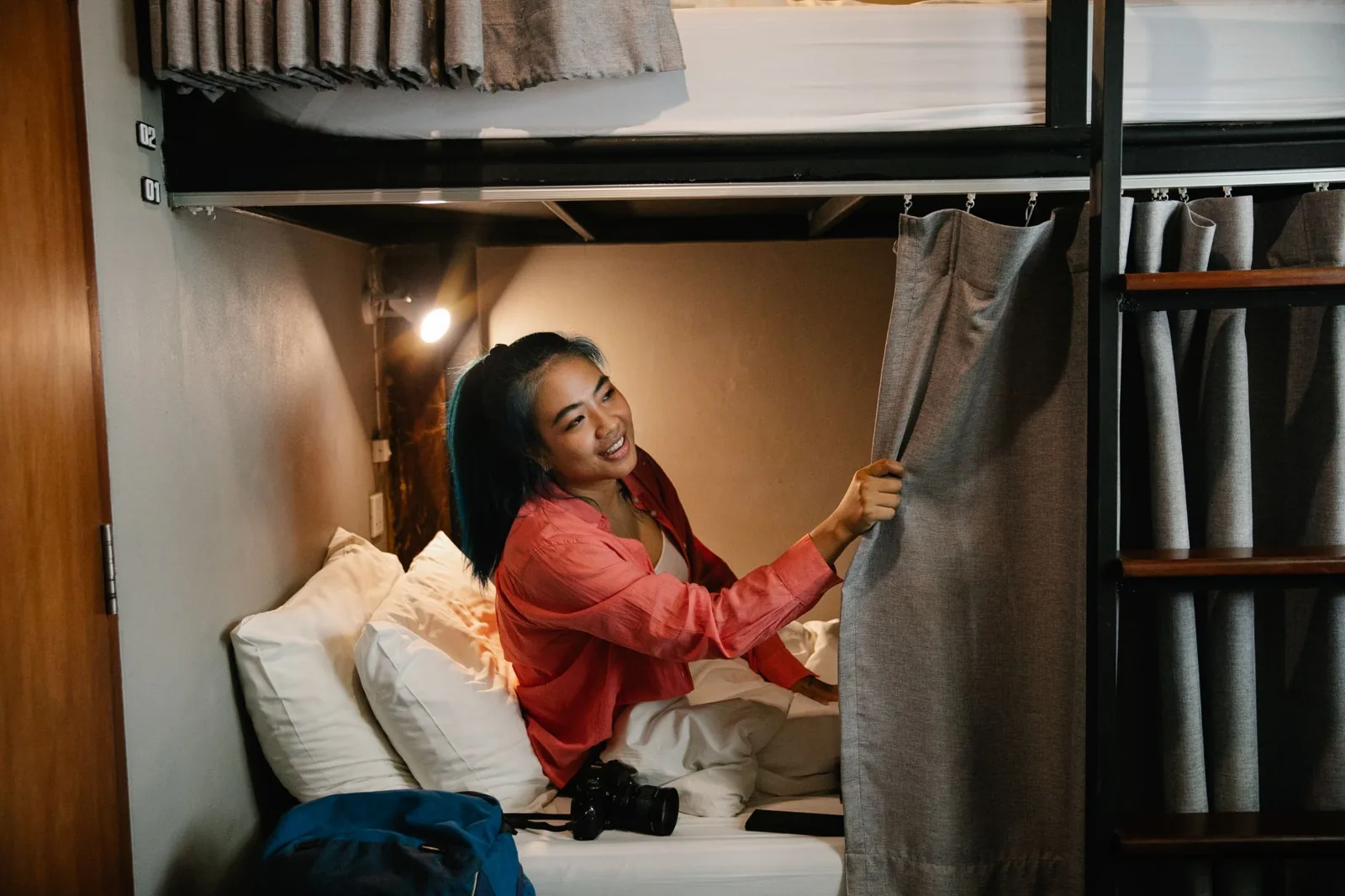
Photo by George Pak via Pexels
When an Airbnb Beats Even the Cheapest Hostel
There is a crossover point where Airbnb stops being the expensive option and becomes the smart one, and it moves depending on the city and the season.
Two or more traveling together. Take a Berlin example: a dorm bed at $32 per person means $64 for a couple. A private Airbnb studio at $70 with no cleaning fee works out to $35 each — and you get a door that locks, a private bathroom, and a kitchen. The “expensive” Airbnb is now the cheaper and better option.
Groups and families. Three or four people split a two-bedroom apartment for $120–$180, or $40–$45 each. A hostel cannot match that on price because private family rooms are rare, and putting four people in a dorm usually costs more per head than splitting an apartment.
Longer stays. Hostels discount weekly stays mildly, but Airbnbs discount them steeply. Booking a month often cuts the nightly rate 30%–50%, and the one-time cleaning fee disappears across 30 nights. For digital nomads and long-stay travelers, the math swings completely in Airbnb’s favor — see our Airbnb vs hotel cost for long stays breakdown for the full numbers.
When you need to cook or work. A full kitchen and a table to work at replace restaurant meals and café spending, which can save $15–$40 a day. That savings is real money and it should be added to the “Airbnb” side of the ledger.
Real Price Breakdowns by Destination
Concrete numbers make the comparison easier to trust, so here are three worked examples based on typical 2025 rates.
A solo traveler in Lisbon
- Hostel dorm bed: $25 per night, no fees
- Airbnb private room: $55 per night plus a $30 cleaning fee over three nights
Over three nights, the hostel runs $75 total. The Airbnb runs $195 plus a service fee, call it $220. The hostel wins by roughly $145, and the traveler keeps the savings for food and day trips.
A couple in Mexico City
- Two hostel beds: $16 each, $32 per night, $96 over three nights
- Airbnb studio: $48 per night, no cleaning fee, $144 over three nights, or $72 each
The Airbnb costs $48 more total, but each person gets a private apartment with a kitchen and their own bathroom. For most couples, that $16-per-night premium is the best money they spend on the trip.
A family of four in Orlando
- Two hostel dorm beds and two private rooms: roughly $220 per night
- Airbnb two-bedroom apartment: $160 per night, plus one $60 cleaning fee
Over a five-night stay, the Airbnb is around $860 with fees, while cobbling together hostel space for four people is impractical and more expensive. Larger groups almost never lose by booking one apartment instead of multiple beds. If you are weighing Airbnbs against hotels instead, our is Airbnb cheaper than hotels guide runs the same comparison the other way.
Frequently Asked Questions
Is a hostel always cheaper than an Airbnb?
No. A hostel dorm bed is almost always cheaper for a solo traveler, but once two or more people share an Airbnb, the per-person cost can drop below hostel rates, especially after the cleaning fee is split across several nights.
Why do Airbnbs cost more than the listed price?
The nightly rate excludes the one-time cleaning fee, Airbnb’s roughly 14% service fee, and local occupancy taxes. Together these can add 25%–40% to the total, hurting short stays the most.
Do hostels charge cleaning fees?
Almost never. The main hidden costs are small extras like towel rental, padlocks, breakfast, and city tax, none of which are mandatory in most hostels.
What is the cheapest option for one night?
For a truly cheap single night, a hostel dorm bed wins almost every time, because an Airbnb’s fixed cleaning fee is not spread across multiple nights. The one exception is a private room with no cleaning fee in a low-cost city.
Is a private room in a hostel worth it over an Airbnb?
It can be. A hostel private room typically costs less than an Airbnb private room and keeps you near the social scene, but it still shares walls and bathrooms. Choose it when price matters more than privacy; choose the Airbnb when you want your own bathroom and a door that locks.
The Bottom Line
Hostel vs Airbnb cost comes down to one number: how many people are dividing the bill. Solo travelers and anyone staying a couple of nights are better off in a hostel dorm, where $15–$60 buys a clean, social bed with no cleaning fee attached. Couples, friends, families, and long-stay travelers should do the Airbnb math, because a private apartment split two or three ways routinely beats the per-person price of separate dorm beds — and throws in a kitchen and a locked door for free.
Prices move fast, so it is worth checking live rates on Kayak for hostels and Airbnbs in your destination the day you plan to book. Then skip the sticker price and look at the checkout total. Add the cleaning fee and service fee to the Airbnb, subtract the towel rental and breakfast you would otherwise buy at the hostel, and decide based on the real number. That is the only comparison that tells you which stay is actually cheaper.